Monday, November 25, 2013

Thanksgiving.. Quail?

     Thanksgiving week is finally upon us, and if you're in charge of the meal, things are about to get pretty hectic. Preparing any holiday meal can be tough, especially the biggest one of the year. I find that people often over complicate things by making too many dishes with too many steps, and if that's not something you do every day, it's going to be stressful. This year, a few of my friends and I will be having a small post-Thanksgiving celebration and we've decided to get together to cook the meal as well. Cooking with friends is always more fun than cooking alone, and the teamwork that it takes to put out a good meal is nothing short of bonding. We're keeping our meal pretty simple, and hopefully the recipes will inspire some ideas in your kitchen for this year's meal.
     Since there are only five of us celebrating, buying a turkey would just be too much food, and we wanted to change it up a bit, so we decided to roast some quail. Quail is mostly dark meat, and you'll need one or two per person, so if you're cooking for the whole family, I'd stick with a turkey. Many people think of quail as a luxury food, only served in high end restaurants, but they're actually fairly cheap and delicious. Rather than making mashed potatoes, we're going to add some texture by making a potato 'risotto,' and because no feast is complete without a salad, we'll also make a simple shaved fennel salad.
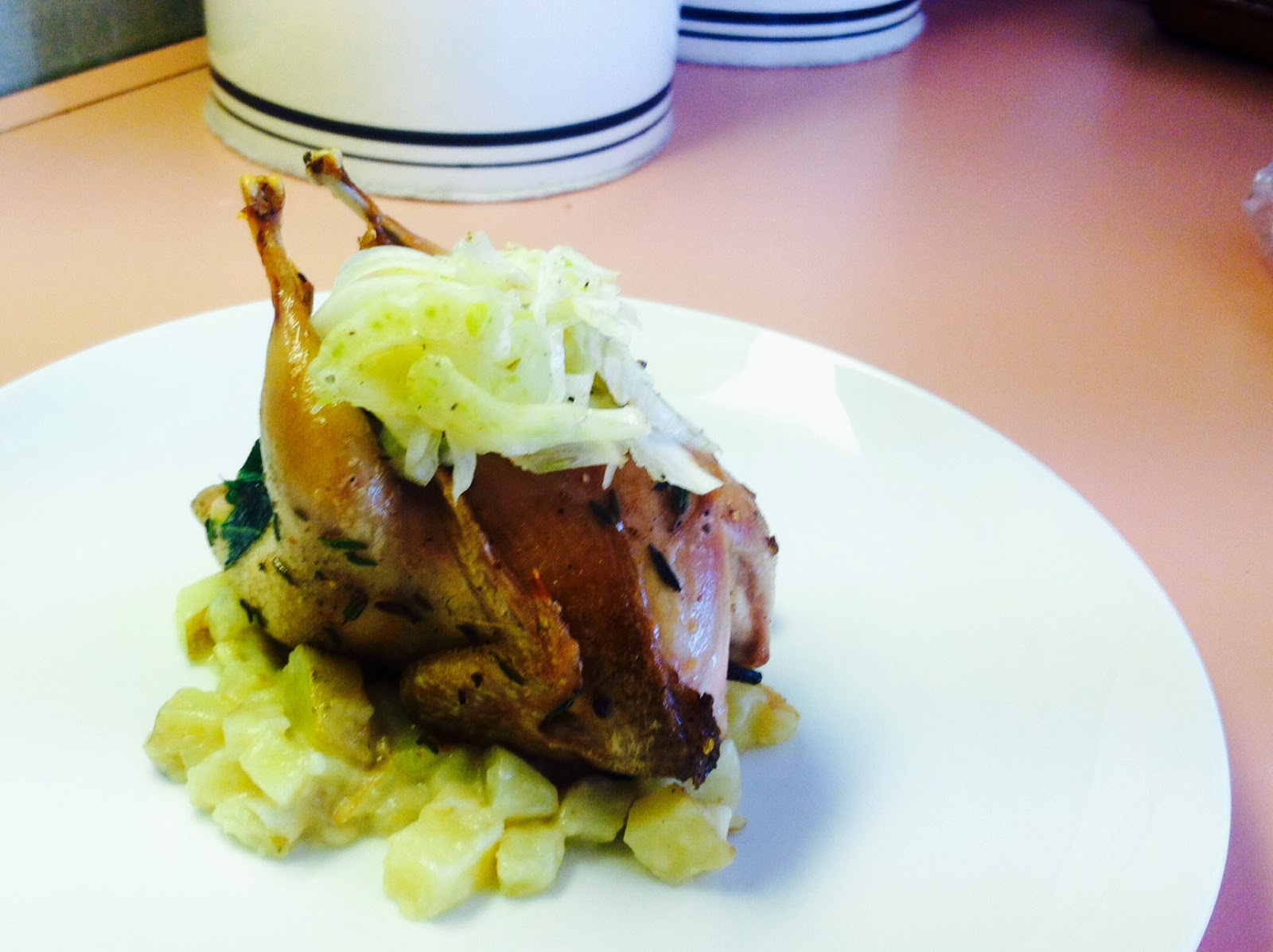
Crispy Roasted Quail with Potato 'Risotto' and Shaved Fennel

Yields enough for a five person meal
Ingredients:
Quail
 10 quail
2 bunches of thyme
10 large collard green leaves, cut into small chunks
2 cloves of garlic, minced
Kosher salt and black pepper, to taste

 Potato 'Risotto'
3 lbs waxy potatoes, such as Yukon Gold or Red Bliss, diced into about 1/4 inch cubes
3 shallots, diced
2 tbsp unsalted butter
chicken stock or water, as needed
1/4 cup heavy cream
grated Parmesan cheese, to taste
Kosher salt and black pepper, to taste

Shaved Fennel
2 medium-large bulbs of fennel, shaved as thin as possible on a mandolin
1/3 cup rice vinegar
1/4 cup red wine vinegar
1 cup olive oil
Kosher salt, pepper, sugar, and thyme leaves, to taste

Quail
     Preheat your oven to 400 degrees Fahrenheit. bring a large pot of water to a boil, and blanch your collard greens for about one minutes, then remove them into an ice bath. Once they are cool, transfer them to a bowl with the garlic and season to taste with salt and pepper. Season the quail well with salt and pepper, and stuff the cavity with your collard greens. holding the drumsticks together, push the legs of each quail in towards the body to plump it up, then tie a piece of string, first around the drumsticks to hold them together, then around the body to keep the legs tucked in. This will promote even cooking and a nice shape to the finished bird. In an oven proof skillet, heat about 1/8 inch of cooking oil (I like to use avocado oil because of its high smoke point) and once it is hot, add your quail, breast side down. Once the skin on the breast is seared and crispy, flip your quail over, add the thyme branches to the pan, and transfer it to the oven. After 10 minutes, remove the quail from the oven and baste it with the juices in the pan. Transfer it back to the oven for another five minutes, or until t is cooked to your desired doneness.

Potato 'Risotto'
      In a large pan, at least a couple inches deep, heat a small amount of cooking oil and sauté the shallots. When they are soft, add the potatoes an
d season with salt and pepper. Cook the potatoes, stirring occasionally, for about 5 minutes, or until most of them are nicely seared. Add enough stock to barely cover them, and cook, stirring frequently, until almost all of the liquid is absorbed. Continue adding stock, about 3 tablespoons at a time, waiting for each addition to dissipate before adding the next, until the potatoes are tender. To finish, add the cream, butter, and cheese. Taste and adjust your seasoning if necessary.

Shaved Fennel
     in a blender, combine all of the ingredients except the fennel and blend, tasting occasionally and adjusting seasoning, until the vinaigrette is frothy and emulsified. In a large bowl, toss the fennel with just enough vinaigrette to coat it. The rest of the vinaigrette can be saved in the fridge for further use.


Thursday, August 29, 2013

Loie Fuller's

A review I wrote for the JWU Campus Herald:

   With the world of culinary arts so quickly becoming engulfed by modernist techniques, it's nice to escape the compressed beets, gelatinized vegetable purees and anything that's been dehydrated and rehydrated. Sometimes in order to really appreciate food, we need to take a step back from impressive techniques and treat our ingredients with respect. After all, when you're in Rhode Island and surrounded by hundreds of passionate local farmers, consistently delivering the absolute highest quality ingredients, why would you want to mask those natural flavors? Thomas Keller has said that the reason he opened Bouchon - his bistro style restaurant - is so that he would have a place to eat after a day of cooking at the French Laundry. Even the greatest chefs cannot deny that simple bistro style food - when prepared well - is a staple cuisine which is both comforting and exciting; something for every person to indulge in. Whether you're a food snob or an anti-foodie, bistro food is something that anyone with an appetite can appreciate. There are a few wonderful bistro style restaurants in Providence, and with classic dishes such as roasted Cornish hen and steak with pommes frites, Loie Fullers is one of the best.
   In 2007, Loie Fuller's opened it's doors on Westminster Street, and they've been delighting Providence diners ever since. On the inside, the décor is best described as elegant. With hand painted murals on every wall and a beautiful mosaic tile floor, the craftsmanship here is excellent. The dining room is pretty small, yet not quite as tiny as many of the newer restaurants that are popping up downtown (north, birch, Figidini, ect.), and the space is very comfortable. One other perk to this restaurant is that because it's out of the way of downtown, in an area where there is more space available, they do have their own parking lot, so those of us with cars don't have to worry about finding parking on the street.

Vegetables and Grits

   Our latest visit to Loie Fuller's was on a Sunday evening, and it was somewhat empty. On a busier night such as a Friday or Saturday, this place gets packed, and the wait for food can get pretty long, so I would suggest coming on a slower night. Our waitress was pleasant and happy to explain everything on the menu to us. She knew the menu pretty well, and the very few things that she didn't know offhand, she promptly went to the kitchen to find the answer. As well as having regular specials, the menu is always changing to suit the season based on what is available from local farms. Many of the ingredients used here come from local farms, and some even come from a farm which is owned by the head chef. To start, we ordered a bounty of appetizers, including the confit duck wings, which were both crispy and tender, tossed in a spicy, sweet sauce making them blissfully sticky and delicious. We also ordered the Loie Fuller plate which is a selection of artisan cheeses, cured meats, and olives; all of which were excellent, especially a particularly strong bleu cheese which had us in awe of it's sharp, full flavor. The polenta fries are another must-try appetizer, fried and crunchy with a smooth house made aioli, although the seasoning was a little uneven, and some fries were perfectly salted, while others lacked some seasoning.

Roasted Pork Loin
   For my entrée, I had the special, which was a roasted pork loin served atop fresh cornbread with a green chile salsa. As unusual as it was to have this type of meal offered in a bistro setting, I thought that having an occasional non-French dishes on special is a nice way for the chef to keep the menu interesting and show that his talent extends far past French bistro cooking. The portion was surprisingly large, and the pork was juicy and fresh. The salsa was quite spicy, and the cornbread, which was warm and fragrant, was made even more delicious by the pork drippings that soaked into it from sitting underneath the pork loin. Other entrees that we ordered included the roasted local Cornish hen, steak frites, and the grilled veggies with grits, all of which were very well executed in classical-French style.
   Overall, our meal at Loie Fuller's was excellent. With elegant décor, friendly service, and well executed bistro food, this is a lovely choice of restaurant for any occasion, whether you're taking out a date or just looking for comforting, tasty food.

Roasted Cornish Hen

Saturday, August 24, 2013

Husk Cherry Clafoutis with Cantaloupe and Cucumber Yogurt

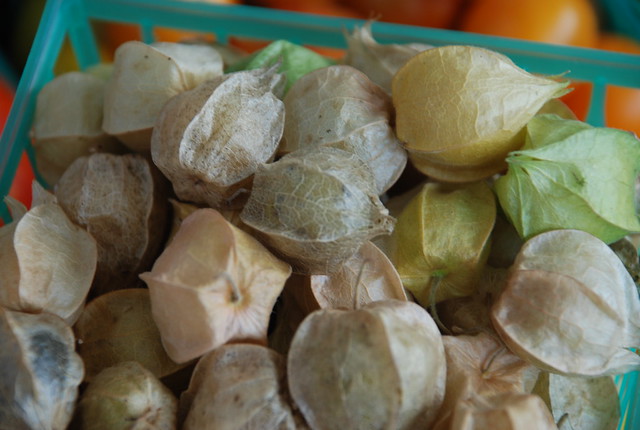
     Every year, it seems as though summer is getting shorter and shorter. It still feels like it has only been a few weeks since the warm weather arrived, although it is already packing up it's belongings and preparing to slowly slip out of our grasp as fall washes over the East Coast. While the end of summer is a sad time for most, it is always a bittersweet time for me. Bitter, of course, because soon the glorious season of abundance will be gone, along with all of the light, crisp summer vegetables. However, it is also very sweet for a few reasons. First of all, the end of summer means that fall is almost here, and nothing is quite as nostalgic and quaint as the corn maze navigating, pumpkin picking, fire-side reading season of autumn. The second reason to love the end of summer isn't because of what is to come in the months ahead, but what is already here - husk cherries. These tiny husked fruit begin to pop up for a short time at farmers markets in New England towards the end of summer, and what a glorious short time it is.
   If you are not familiar with husk cherries, they look - at first glance - like miniature tomatillos, carefully wrapped in a delicate natural packaging, giving them a great presentation as an after-dinner-snack when entertaining guests. Although the husk isn't what makes this fruit so special. Once you unwrap a husk cherry, it is a small yellow cherry-tomato-looking thing with a very unique taste. Some people say that they taste like pineapples, while others compare them to mangos. To me, the flavor falls somewhere between a mango, a kumquat and a sweet, just picked tomato.
    Recently, I found some husk cherries at a farmers market, and I wasn't exactly sure what to do with them. While the idea of a chutney or tart sounded delicious, I couldn't help but feel like such a unique and rare fruit needs to be treated simply and left whole, so that it can be appreciated for exactly what it is. I eventually settled on a clafoutis-kind-of. A clafoutis is an old school rustic French dessert. The kind of thing that house wives have been making for ages. A traditional French clafoutis consists of cherries, which are placed in a baking pan and have a almond-flavored custard batter poured over them before being baked in the oven. This recipe differs from a traditional clafoutis in two ways. First, that we will be using husk cherries instead of cherries, and second, that we will be using vanilla extract to flavor the custard rather than almond extract. I personally find that the delicate flavor of vanilla does more to compliment the light sweetness of the husk cherries, although you can use almond extract if you prefer. This dessert tastes best when served still-warm with a spoonful of a cold cucumber and cantaloupe melon yogurt to offset the sweetness with tart and refreshing flavors.
 
 
Husk Cherry Clafoutis
1 Pint Husk Cherries
2 Large Eggs
2/3 Cups sugar
2/3 Tbsp Flour
1/2 Cup Whole Milk
1/4 tsp Vanilla Extract
 
Preheat an oven to 375 degrees. Butter and flour a gratin dish or oven-safe pan and spread the husk cherries evenly throughout the bottom of the pan. In a separate bowl, beat the eggs along with the flour and sugar. When they are well beaten, add the milk and vanilla extract. Pour your custard batter into the baking dish, just enough to almost cover the husk cherries. Put the clafoutis in the oven until the top begins to brown and it is cooked through. A knife or fork - when inserted into the custard - should come out clean. While your clafoutis in baking, you can make this simple yogurt topping.
 
 
Cucumber Cantaloupe Yogurt
 
Plain yogurt(Preferably from a local artisan producer such as Narragansett Creamery)
Cucumber, finely diced
Cantaloupe, finely diced
 
 
You may have noticed that there are no quantities listed for these ingredients, and that is mostly because there really is no right or wrong way to make this. Add more or less of each ingredient as you would like. The cantaloupe adds sweetness; the cucumber adds a refreshing element and the yogurt adds a tart flavor, so keep that in mind when choosing your quantities. Of course, if it doesn't come out how you would like, then you can always add more of any ingredient, and if plain yogurt is too tart for you, feel tree to add some honey or agave nectar. To prepare the sauce, simply fold the cucumber and cantaloupe gently into the yogurt Be careful not to mix your yogurt too much or it will become thin and runny. To serve, wait for your clafoutis to cool to just above room temperature, use a spatula to scoop some onto a plate, and add a spoonful of the yogurt. This makes an excellent sweet treat for a summer afternoon spent sitting in the sun.


Wednesday, August 14, 2013

On Gnocchi

     Ah, gnocchi (pronounced nyaw-kee): what fond memories I have of thee. If you are not familiar with gnocchi, you're missing out. These adorable little dumplings are a traditional Italian treat, made with either potato or ricotta cheese, boiled, and often seared in butter or tossed with an herby sauce. But, of course, my love for gnocchi goes far beyond their unique taste and texture. As with any true human-food-romance, I share a sort of emotional connection with this dish, and with the fact that each dumpling is completely different and tells its own story.

Exhibit A (Photograph is from http://www.sallypasleyvargas.com, an absolutely wonderful food blog):
   Notice the shape of these dumplings, and the fork on the bottom right. Gnocchi have a unique ridged shape that, when home-made, must be done by hand with either a fork or a nifty little tool called a gnocchi board - but I prefer using a fork for a more rustic outcome, as well as a much more nostalgic experience. Now those ridges means that each and every single dumpling is handled individually, crimped by hand with a fork, and inspected by the gnocchi-artist for quality assurance. A plate of homemade gnocchi is special in a way that not many foods are, and that is that each single gnocchi on that plate is a little different, and that they were each made and shaped with a huge amount of time and love. Fresh gnocchi isn't a plate that can just be slapped together on your lunch break, but with a little time and a lot of care, you can create something truly amazing that will not only taste great, but it will make you feel great knowing that you crafted your dinner from scratch.
   For a long time, gnocchi was almost unheard of in the states, even on the east coast where "Italian" culture is pretty popular. I have vivid memories of going to "Italian" restaurants of the late 90's and asking for gnocchi, only to be met with a blank, confused stare by a waiter who had obviously never heard the word in his life. Also, I remember quite well one particularly amusing classroom moments during my first year of culinary school, involving a student who was assigned a recipe for gnocchi, and - having never heard the word - sounded it out as ga-noh-chee. He spent the first 30 minutes of class asking if anyone had ever heard of ga-noh-chee before someone finally explained what they were and how to pronounce them. He had changed majors by the end of the trimester. Now does that mean that they was impossible to find until recently? Of course not! It was just a bit of a scavenger hunt. Although that has changed, and gnocchi can be found at the tables of many rustic Italian restaurants and bistros today, but the obvious truth is that no restaurant gnocchi will ever compare to what you can make at home. For me, gnocchi are a great go-to item when I'm planning dinner for my family or friends. Not only does the flavor and craftsmanship impress, but many Italian friends have never seen or heard of this authentic dish, and there's no better feeling than introducing a friend to their new favorite food.

As previously stated, gnocchi can be made from either potato or ricotta cheese, so here are the recipes that I use for each dough.

Ricotta Gnocchi


2 cups ricotta
2 large eggs, lightly beaten
1 1/2 cups grated Parmesan cheese
all-purpose flour as needed
1/2 stick unsalted butter
salt to taste

Potato Gnocchi

6 russet potatoes, baked, skinned and mashed (or some of last night's leftover mashed potatoes)
4 egg yolks
all-purpose flour as needed,
salt to taste


   For both dough recipes, start by combining all ingredients except flour in a bowl. Slowly add flour while mixing until a soft, somewhat sticky dough is formed. Once your dough is formed, you do not need to let it rest before forming your gnocchi. To form your gnocchi, simply take a handful of dough, and roll it out into a log, about 1/2 in or larger if you want bigger gnocchi. Using a knife, cut your dough log into pieces, depending on how large you want them to be. Now comes the fun part.
   

   Take one of your gnocchi and roll it into a ball between your hands. Then, roll it gently over the back of a well floured fork. You should end up with small oval dumplings with even ridges. Don't get discouraged if your first few gnocchi don't come out well. It takes some practice to learn the technique, but it's well worth the practice, and rolling gnocchi with your family or friends can be a fun social event before dinner. Once your gnocchi are formed, lay them out in a single layer on a floured surface. When you're ready to cook them, just drop them into a pot of salted boiling water. Unlike homemade pasta, fresh gnocchi will take a couple of minutes to fully cook through, and they can be doughy when not fully cooked.
   As for sauce, I like to keep it simple. Gnocchi go great with three things: butter, herbs and vegetables. I like to saute some herbs and garlic in a little butter while my gnocchi are cooking. When they're finished, I toss my gnocchi in the pan with the butter and let them get brown on one side. Be sure to do this in small batches to avoid over-crowding your pan. If you want to add vegetables, add them before the gnocchi to let them cook, or precook them and toss them in with your finished gnocchi.

Ricotta Gnocchi with Rosemary and Oven Roasted Beets

Potato Gnocchi with Basil, Chives and Pickled Radishes

Wednesday, June 5, 2013

birch

This is a short piece that I wrote for the JWU Campus Herald. Enjoy!


It all started with “Hello!;” the first tweet from @birchPVD, the Twitter moniker of soon-to-be restaurant, birch. Ben Sukle, nationally acclaimed chef, chef at Providence’s The Dorrance and Johnson & Wales University graduate, with his wife, Heidi, are opening a brilliant new restaurant at 200 Washington street (The space formerly occupied by Tini) which already has the whole food scene buzzing with anticipation. birch is set to open in mid June. 
Sukle is known for his unique approach to food, in which, not a single ingredient goes unnoticed. Ben puts time and passion into selecting the finest produce, meat and seafood from small, local farms and distributors. The menu at birch will focus on exactly that, with a small, a la carte menu which will be constantly changing with the seasons, and with ingredient availability. So far, 2013 has brought amazing restaurants to Providence, such as The Grange, and everyone is expecting to welcome birch as a perfect new member of the cities incredible, vibrant food scene. For more information, check out www.birchrestaurant.com or follow @birchPVD on Twitter.

Thursday, May 23, 2013

Thyme & Paprika Grilled Chicken w/ Spicy Cucumber Apple Chutney & Grilled Radishes

     Summer is finally here, and for seasonal food lovers everywhere, that means one thing: Grill weather. If you've ever lived through a summer in America, then you're most likely very well acquainted with grilled chicken. A dish which all too often ends with dry, flavorless, slightly tough meat, accompanied by under-thought side dishes, or even worse, nothing. But with a little bit of care and creativity, paired with a few fresh vegetables, we can recreate this classic dish, and take it from kind-of-boring to new and delicious.

     The first thing we have to contemplate is the chicken. If you want to get chicken at your grocery store, that's fine, and it certainly won't ruin your final product, but if you really want the flavor of the chicken to shine through and add another layer of flavor to your dish, then you want to find fresh, chemical free chicken. You can find truly fresh chicken at your local farmers market, and you can buy directly from some of the local farms in your are. For a full list of local poultry farms, click here. My chicken is - of course - from Baffoni's Poultry Farm in Johnston. If you're not a regular eater of local meat and produce, I highly suggest trying it at least once. The difference in flavor is a lot larger than you would imagine and you'll be pretty surprised when you actually taste the flavor of chicken for the first time in your life. After being genetically modified, stripped of any relatively natural living conditions, and shipped halfway across the world, chicken tends to lose almost all of it's natural, fresh flavor by the time it hits shelves at your local grocery store. I like to use leg quarters when grilling. The dark meat holds up to the heat without drying out, and cooking meat with the bone-in extracts a lot of flavor from the bone into the meat. However, if you prefer white meat, then use the breast. Cooking is all about using the ingredients and flavors that YOU like.

     Once we have our chicken, the next thing to contemplate is seasoning. One of the biggest mistakes people tend to make when seasoning meat for the grill is using seasoning as flavor. Remember, we just spent time sourcing fresh local chicken, and we want that flavor to shine through. Seasoning should be used to enhance the natural flavor of our chicken, not to cover it. I like to keep my seasoning simple. I start with salt and pepper, and like to use one herb and one spice. Two of my favorites for chicken ate thyme and paprika. Remember, we want to season the meat, not flavor it. Over-seasoning is just as bad as under-seasoning, and with a little practice, you'll find your perfect balance. Once your chicken is seasoned, it's ready to hit the grill, which should be heated to around 400-450 degrees. If you're using white meat, it will cook a lot faster than dark meat, so check constantly and be careful not to overcook it.

     Alright; our chicken is perfectly seasoned, and cooking away. Now we're getting somewhere. Now it's time to start thinking about sides. One of my absolute favorite grilled side dishes is simple, tasty, and completely under-utilized by so many home cooks: grilled radishes. Some people are scared away from using radishes because they don't like the spice of raw radishes, but when they're cooked, they lose their kick and gain a flavor that falls halfway between potatoes and roasted cauliflower. If you've ever picked a radish, you know that by the next day, they've already started to lose some of their flavor, so it makes a big difference to buy fresh, local radishes, especially when they're so easy to find at just about any farmers market in Rhode Island. I like to quarter my radishes, and toss them with olive oil, minced garlic, salt and pepper. If your grill's grate is too big, and you think your radishes will fall through, you can cook them in a sauté pan, or leave them in larger pieces. Cook these until they're brown on all sides and tender all the way through.

     While your chicken and radishes are finishing up on the grill, we have one more component to this meal that needs to be made. No summer time grilled dish is complete without a cold component. For this dish, I'm making a cold chutney. More specifically, a spicy cucumber apple chutney. This is a simple side for the chicken which will add a spicy kick, as well as balance out the smoky paprika with sweet , fresh flavors. For this chutney, we'll start with one cucumber, peeled and diced, as well as one apple and one pear also diced. To this we'll add a tiny pinch of salt. We don't want our chutney to taste like salt, but we want just enough to help bring out the natural flavor of the fruit. Finally, we'll add minced cilantro, to give the chutney a refreshing flavor, and sriracha for a spicy kick. Add as much, or as little as you like, depending on how well you handle spicy food.

     When our chicken and radishes come off the grill we're finally ready for a delicious, fresh summertime feast.

     Hopefully you're inspired to add some creative twists to your summertime grilling this year. To keep up with this blog, you can follow us on Twitter and Facebook. Happy noshing!

Thursday, May 16, 2013

The Duck & Bunny Restaurant Review

Hello all! Sorry that I haven't posted anything on here in so long. I've been incredibly busy with final exams and a new job. Here is an adaption of a restaurant review which I wrote on The Duck & Bunny for the JWU Campus Herald this spring. Enjoy!

Snuggery: (snŭg'ə-rē) n. a cosy and comfortable place

     In America, we've adopted a pretty stressful lifestyle. Between the time we spend trying to balance work, school, family and a social life, we all need some time to relax and enjoy life, and that's why there are places like The Duck & Bunny. The Duck & Bunny is a cozy, quaint little restaurant built in a house on the east side which offers an elegant, yet laid back environment with friendly, approachable staff, and creative French comfort food.
     From the minute we stepped foot in The Duck & Bunny, we felt the hominess which emanates throughout every aspect of the restaurant. Everything about the décor- from the elegant, white cushion which lined the walls, to the fireplace which was left from the house in which The Duck & Bunny was built- gives it a very comfortable vibe, making it a perfect place for a casual brunch, a delicious meal, or afternoon tea and cupcakes. Since it was a Tuesday night, there were plenty of open tables, and we were seated as soon as we walked in. The wait staff were all very welcoming, and are thoroughly trained. Our waiter managed to take our order- for five people- without writing down a single thing, which shows a thorough knowledge of everything on the menu. When I commented on being impressed by remembering an order for five, he told me that his current record is a table of twelve, with no mistakes.
     The chef at The Duck & Bunny manages to match the creativity and comfort of the décor in the menu, which is based mostly on one of my all time favorite foods: the crepe. Among our order was The Miss Harriet, a crepe with brie, pear, and scallion; the crepeccini, a bowl of crepe-noodles tossed in pomodoro beurre blanc; the roast beef and gorgonzola crepeccini, a bowl of crepe-noodles with roast beef and a mushroom and gorgonzola cream sauce; The strawberry and grilled pear salad with goat cheese; and the PB&B, a massive toasted sandwich of peanut butter and banana on nearly-inch-thick sweet bread. the relaxed, comfortable nature of the seating and atmosphere makes waiting for food anything but an unenjoyable experience, and after about fifteen minutes, our food had arrived.
The Miss Harriet was the first item on my to-taste list. The crepe was thin and fluffy with a slight buttery crispiness on the outside. The pears were sweet and slightly acidic, making a perfect flavor base for the crepe, and the creaminess of the brie was the perfect way to counter the flavors and prevent the pears from adding too much sweetness to the crepe. Next, was the crepeccini, which was a blissfully inventive use of crepes. The beurre blanc was perfectly executed, making a tangy, acidic sauce with enough fat to coat the crepe-noodles well. The crepeccini with roast beef was another delicious take on the concept of crepe noodles, with rare beef, and a creamy, salty gorgonzola and mushroom sauce. One of the most unexpected delights amongst our order, however, was the PB&B. Expecting a small, simple sandwich of peanut butter and banana, we were all shocked by the monstrous, sugar-coated, toasty, gooey sandwich which arrived at our table.
     Over all, our experience at The Duck & Bunny was absolutely delightful. It's obvious that the staff here puts a lot of thought and passion into making every aspect of the customer experience enjoyable and comfortable. If you're searching for a sanctuary from all of the worries and stress of life, then I highly suggest clearing some time if your schedule and making a visit to The Duck & Bunny on Wickenden St. For a full menu, as well as hours, head to www.theduckandbunny.com